
ArMA Member Spotlight: Edward Kalpas, MD, MAS, MPH!

December 13, 2024

We're proud to introduce Edward Kalpas, MD, MAS, MPH as ArMA's December Member Spotlight!
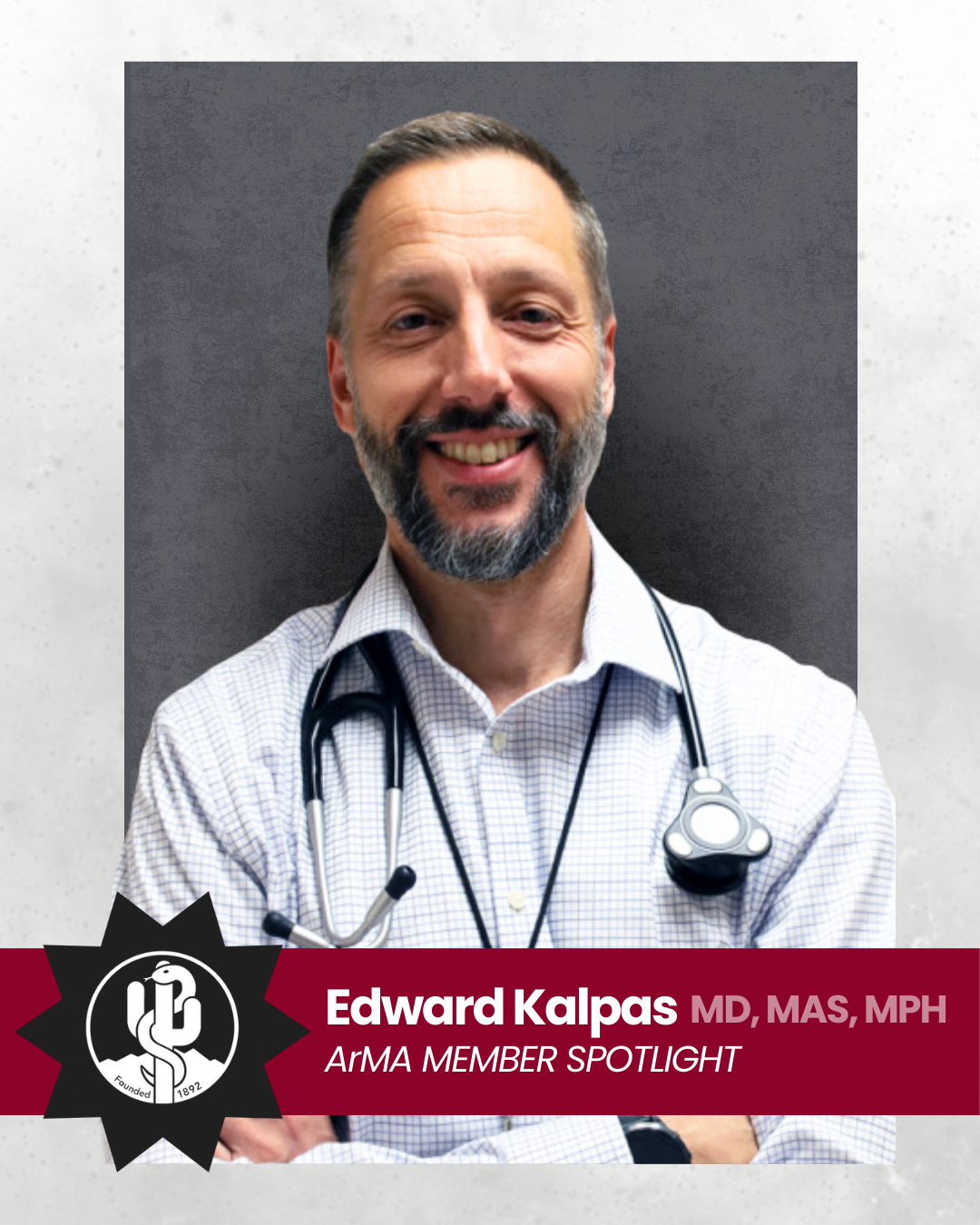
Portrait of Leah Sanford in glasses, smiling against a gray background with a purple frame and award badge.

Dr. Kalpas received his master's in public health from Columbia University, his medical degree from Uniformed Services University, and his master's in health informatics from Arizona State University. Dr. Kalpas found his way to the Valley, where he worked with organizations like HonorHealth, taught classes at Arizona State University's College of Health Solutions, and conducted research at The Translational Genomics Research Institute (TGen).


Most recently, Dr. Kalpas joined the Community Health Center of Yavapai as chief medical officer. In this role, he is empowering patients and healthcare professionals to improve healthcare through technology. In our interview with Dr. Kalpas, he shines a much-deserved spotlight on rural healthcare.


Learn more about Dr. Kalpas's story below!

What led you to practice in Yavapai County specifically?


"Yavapai County Community Health Services contains both a County Public Health Department and Federally Qualified Health Center in one department. As the Chief Medical Officer of this integrated department, I get to bring Public Health interventions directly into the primary care setting in addition to leveraging our primary care, pediatric, OB/GYN, dental and behavioral health providers to improve the health of the entire county.

This unique role allows me to fully utilize my training in public health, preventive medicine and clinical informatics. I still get to see patients part-time and also mentor students which are all important to me."


What is your favorite thing about serving that community?


"It is truly fulling to work in an underserved area. We see all types of patients from those with no insurance to patients with Medicaid, Medicare or commercial health insurances.

We have areas that are more densely populated such as Prescott and Prescott Valley and rural areas extending from Ash Fork and Seligman in the North to Cottonwood and Camp Verde in the East, Bagdad in the West, and Yarnell and Congress in the South.

In addition, it is a very collaborative environment where we work closely with our colleagues from Yavapai Regional Medical Center, the Prescott Veterans Affairs Medical Center and Northern Arizona Healthcare. As a department of Yavapai County government, we have been able to forge strong relationships with Yavapai College, and several school districts."


What hurdles have you and your team overcome in the rural health landscape?


"It is challenging working in an area with insufficient specialty providers. We often have to send patients to Phoenix or Flagstaff for specialty care and this can be challenging, particularly when patients don't have reliable access to transportation."

How did your military service prepare you to lead in a medical environment?


"I learned in the Army to 'Leave No One Behind'. This prepared me for my current position where I'm committed to bringing quality healthcare to every Yavapai County resident."


What prompted you to become involved in organized medicine?


"I first became involved with ArMA as a member of the Residents and Fellows Section where I was the Vice-Chairperson. I wanted to advocate for Graduate Medical Education participants and network with other providers in Arizona."

Why is ArMA important to you and those you lead?


"As of member of the ArMA Public Health Committee, I feel it is important to advocate for the the physician specialty of Public Health and General Preventive Medicine. Many physicians and medical students I've talked to don't know there is a residency and board certification in this area."


What song has been on repeat lately?


"Little Blue - Jacob Collier"


Where is your favorite place to grab a bite in Arizona?


"Pomo Pizzeria is my favorite restaurant in Arizona. Both my parents grew up in Italy and I got to visit Italy every summer to visit my grandparents when I was growing up. This is the most authentic Neapolitan pizza I've found in all of Arizona."


If you weren't pursuing medicine, what would you be up to right now?


"If I wasn't practicing medicine, I would be at a meditation center, flying airplanes, taking personal development courses or scuba diving."


What would people be surprised to learn about you? 


"I developed and taught a course at Stony Brook University called 'Geniuses of Italian Science'. We learned about important scientists from Italy ranging from Leonardo Da Vinci to Enrico Fermi."


How do you unwind after a stressful day? 


"I like to ride my mountain bike, go trail running, play guitar, meditate or take my golden retrievers Hugo and Mr. Chips to the dog park."


By Admin User • September 18, 2026
Statewide orders keep pharmacists and physicians authorized to vaccinate Arizonans amid uncertainty over the next ACIP meeting. Statewide Orders Cover the 2026-27 Flu & COVID Season The Arizona Department of Health Services has issued statewide standing orders supporting access to the 2026-27 influenza and COVID-19 vaccines approved by the U.S. Food and Drug Administration. Arizonans seeking a flu or COVID-19 vaccine should contact their physician or pharmacy to confirm availability. Why the Orders Were Issued Arizona pharmacists may administer vaccines recommended by the Advisory Committee on Immunization Practices, vaccines recommended by the Centers for Disease Control and Prevention for international travel, or vaccines authorized under a prescription, including a physician-issued public health standing order. With the timing of the next ACIP meeting uncertain, ADHS worked with the Arizona Board of Pharmacy to issue statewide standing orders for the flu and COVID-19 vaccines, which function as a prescription allowing pharmacists and physicians across Arizona to administer them to anyone who wants one. ADHS Medical Advisor Weighs In "Vaccines are one of the most important tools we have to protect our communities. The Influenza and COVID-19 vaccines have been proven safe and effective at preventing severe illness, hospitalization, and death. Vaccines help us limit the spread of disease, reduce pressure on our healthcare system and reduce costs," said Dr. Richard Carmona, ADHS public health medical advisor and the 17th U.S. Surgeon General. "We have issued these standing orders to ensure safe and timely access to the vaccines in alignment with scientific and evidence-based guidance." What Arizonans Should Know The standing orders do not require every pharmacy to offer vaccinations, and they do not guarantee insurance coverage for administration. Coverage and out-of-pocket costs vary by plan, so Arizonans should check with their insurance provider before scheduling an appointment. 
By Admin User • September 18, 2026
State attorneys seek an emergency stay after lower courts reject bids to delay receivership of the prison health care system. State Makes a Last-Ditch Appeal Attorneys for the Arizona Department of Corrections, Rehabilitation and Reentry asked the U.S. Supreme Court this week to delay a court-ordered receivership of the state's prison health care system. The request comes after both a federal district court and the 9th U.S. Circuit Court of Appeals declined to pause the takeover. In the recent application, former U.S. Solicitor General Paul Clement, a representative of the department, argued that the state deserves more time to make its case before surrendering control of its operations, including oversight of its employees and health care budget. Roots of the Case The dispute began in 2012 when inmates sued the department, alleging the prison system's inadequate medical, mental health, and dental care amounted to cruel and unusual punishment under the Eighth Amendment. The case went through years of litigation and a failed settlement agreement. In 2023, U.S. District Judge Roslyn Silver ruled that the health care system was "grossly inadequate." The court ordered the prison healthcare system to comply with more than 150 "quality indicators," but according to court-appointed monitors, the department failed to comply with 131 of the measures. In light of this finding, Silver named Annette Chambers-Smith, former director of the Ohio Department of Rehabilitation and Correction, to take over as receiver effective Oct. 19. Arguments on Both Sides Clement argues receivership should be the last resort and that Silver moved to it too quickly. He asserts that the department has made measurable progress, including growing its health care staffing by more than 50%, expanding substance-use treatment access, and adopting a new care model. Corene Kendrick, deputy director of the American Civil Liberties Union National Prison Project, which represents the roughly 25,000 people incarcerated in Arizona prisons, called the department's request a "Hail Mary" and said Silver had given the department years of opportunities to comply before ordering receivership. What Happens Next The Supreme Court has not yet set a deadline for the plaintiffs to respond to the stay request. Separately, the 9th Circuit is now reviewing the merits of the receivership order itself. The department filed its opening brief on Sept. 15, and the plaintiffs' response is due Oct. 15. Information in this article was sourced from the Arizona Mirror .