Mental Health Parity Index Reveals Gaps in Arizona & Nationwide

April 16, 2026

New national data from the Mental Health Parity Index, a project spearheaded by the American Medical Association and several other organizations, shows that mental health care continues to lag behind physical health services in insurance coverage despite longstanding federal parity laws.

State

Number of licensed PH clinicians

Number of licensed MH/SUD clinicians

Percent PH clinicians in-network

Percent MH/SUD clinicians in-network

Percent difference

Arizona in-network rates for physical health (PH) and mental health/substance use disorder (MH/SUD) clinicians. Source: AMA Mental Health Parity Index.

Arizona

44,358

16,164

59.5

51.8

13.7
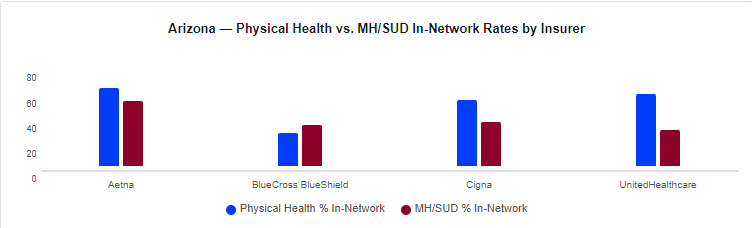
In-network rates for physical health vs. mental health/substance use disorder clinicians by major Arizona insurer. Source: AMA Mental Health Parity Index.

Persistent Gaps in Mental Health Network Access and Reimbursement


The findings reveal persistent gaps in access to in-network care, with many patients struggling to find covered mental health clinicians. Reimbursement disparities are also significant. Mental health clinicians are paid 16% to 59% less on average than their counterparts in physical health, a disparity that can directly influence whether physicians participate in insurance networks.


What Arizona Physicians Are Seeing


For Arizona physicians, these trends mirror everyday realities. Limited networks and lower payment rates contribute to longer wait times, increased out-of-network care, and added strain on primary care physicians managing behavioral health needs. 


Federal Parity Law Enforcement Falls Short


The report points to ongoing shortcomings in enforcement of the 2008 Mental Health Parity and Addiction Equity Act, which requires insurers to cover mental health services similarly to medical and surgical care. With gaps identified in network adequacy, payment inequities, and barriers to access, the report underscores the need for stronger oversight and insurer accountability.


A Call to Action for Arizona's Medical Community


For Arizona's medical community, the message is direct: closing that gap will require not only policy enforcement, but sustained physician engagement at every level of the health care system.


Data source: AMA Mental Health Parity Index, American Medical Association.

By Admin User August 7, 2026
Abrazo Arizona Heart Hospital Launches Largest Expansion in Its History Investment Expands Inpatient and Procedural Capacity to Meet Rising Demand for Cardiovascular Care The Abrazo Arizona Heart Hospital in Phoenix announced last week that it is undertaking the largest expansion in its history. The new construction will add inpatient and procedural capacity to serve more Arizonans in need of heart and vascular care. Meeting Arizona's Growing Demand for Heart Care Abrazo explained that the expansion is necessary to support Arizona's continued population growth, which is driving increased demand for cardiovascular services. The added capacity will allow the hospital to not only treat more patients requiring cardiac, vascular, and critical care, but also continue its participation in clinical research and innovation.  Part of a Multi-Year Investment Strategy In its press release, Abrazo describes the expansion as the latest phase of ongoing, multi-year investments intended to advance care and meet the evolving healthcare needs of communities across the state. The hospital did not report an anticipated completion date for the project. Source: Abrazo Health
By Admin User August 7, 2026
Hobbs Highlights Milestone in Ongoing Partnership With Undue Medical Debt Gov. Katie Hobbs announced this week that more than $1 billion in medical debt has been erased for nearly 671,000 Arizonans, marking a significant milestone in the state's ongoing partnership with the nonprofit Undue Medical Debt. How the Program Works The initiative, first launched in 2024, purchases qualifying medical debt from hospitals and collection agencies for a fraction of its value before eliminating the debt entirely for eligible patients. Who Qualifies According to the governor's office, recipients do not need to apply for the program. It is available to Arizona residents who: Receive low- and moderate-income Have medical debt that represents a substantial share of their annual income A Flashpoint in the 2026 Election Season Healthcare affordability has been at the forefront of Arizona's political conversation as the 2026 election season intensifies. Supporters argue that relieving burdensome medical debt can improve: Families' financial stability Creditworthiness Willingness to seek needed healthcare Critics of similar programs have generally questioned whether debt forgiveness addresses the underlying drivers of rising healthcare costs or simply treats the financial consequences after care has been delivered. As debates continue over healthcare affordability and access, Arizona's medical debt relief initiative is expected to remain a prominent example in broader discussions about how states can help patients facing significant medical expenses.