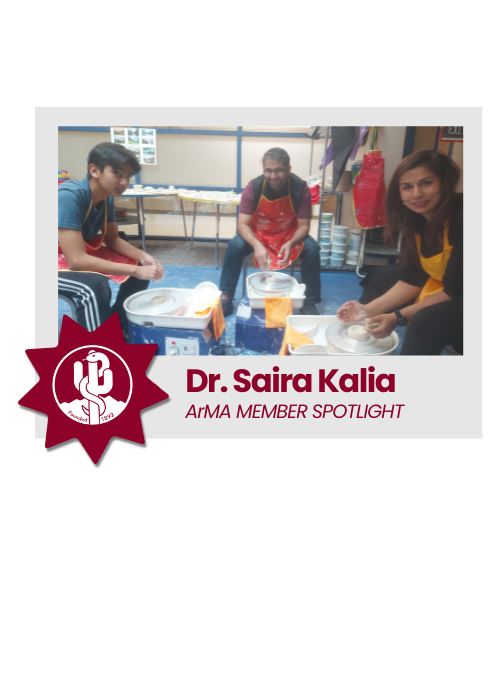
Member Spotlight: Saira Kalia, MD
We're proud to introduce Saira Kalia, MD, as ArMA's August Member Spotlight.
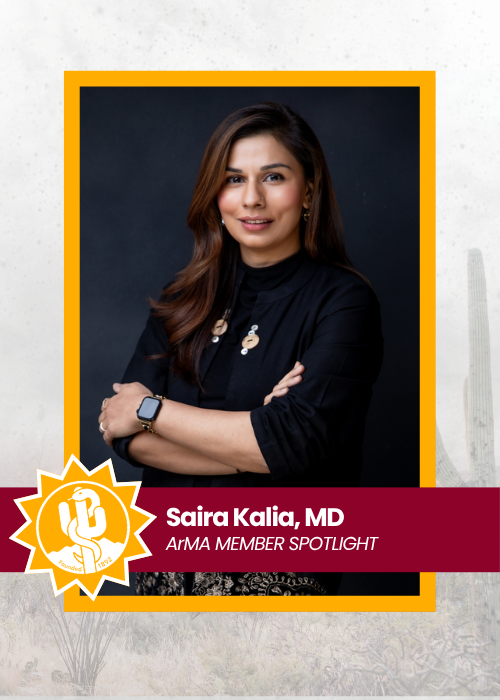
Dr. Saira Kalia is a psychiatrist practicing in Tucson who has dedicated her career to supporting women's mental health during some of life's most transformative moments. She founded and directs the Perinatal & Pediatric Psychiatry Access Lines (APAL), a groundbreaking program addressing Arizona's need for maternal and pediatric mental health resources.
In her interview, Dr. Kalia shares how her journey with perinatal psychiatry began, her passion for systemic change in maternal mental health care, and the lessons learned from building statewide access programs. She also shares some of her proudest and most memorable moments, many of which involve the joy and experience of being a mother.
Dr. Kalia's work represents the intersection of clinical excellence and systems thinking, demonstrating how physicians create lasting impact beyond the exam room.
Read more about Dr. Kalia and her vision for the future of maternal mental health below!

What drew you to the field of perinatal psychiatry? When did you first discover your passion for delivering care to perinatal patients?
I've always known that I would work with women in some capacity — that part of my path felt clear even before I went into medicine. During medical school, it became even more apparent that supporting women's mental health was where I belonged. I was struck by how central mothers are to the health, stability, and wellbeing of families and communities — and yet how often their needs are overlooked, especially during transitions like pregnancy and postpartum. Those moments are profoundly vulnerable and transformative, and they deserve more attention, not less.
Working in perinatal psychiatry has been both a passion and a privilege. It's deeply humbling to walk alongside someone as they navigate the emotional complexities of becoming — or being — a mother.
What would people be surprised to learn about you?
People are often surprised to learn that I love dystopian coming of age fantasy novels. My son and I read them together and debate over the merits of different powers.
What recent development in maternal mental health are you most excited about?
The growing national recognition of maternal mental health as a public health priority has been incredibly encouraging. In particular, I'm excited by the integration of psychiatric consultation services into primary care and obstetric settings — including models like perinatal psychiatry access programs — which make timely, expert support available to front-line providers.
Additionally, the inclusion of maternal mental health metrics in federal quality reporting programs is a game-changer. It signals a shift toward accountability and sustainable systems of care.

What has been the biggest challenge for maternal mental health in the past five years? What does the path towards a solution look like?
The most pressing challenge has been the workforce shortage — both in mental health broadly and in reproductive psychiatry specifically. We simply do not have enough trained clinicians to meet the growing need, especially in rural and underserved areas. The solution lies in capacity building: equipping non-specialist providers to offer competent care, investing in pipeline training, and scaling programs that deliver consultation, education, and resource navigation. We also need to continue advocating for policy and reimbursement changes that make integrated, longitudinal care feasible.
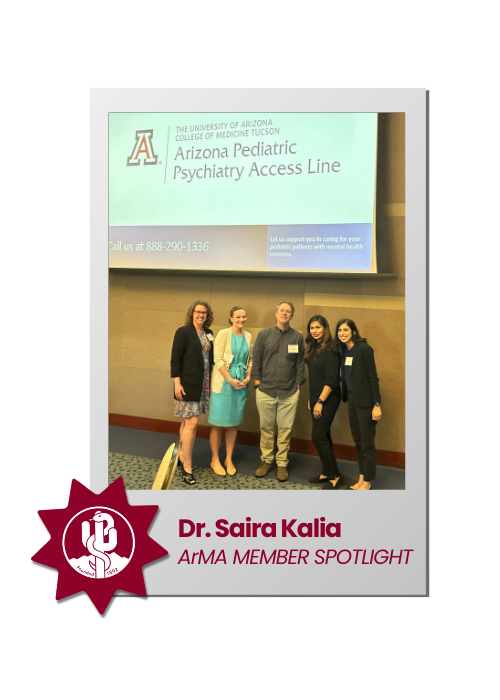
You serve as director of the Perinatal & Pediatric Psychiatry Access Lines, a program you founded in response to Arizona's lack of maternal mental health resources for patients and physicians. What has been the most important 'lesson' you've learned through leading the program?
The most important lesson has been that relationships are the foundation of systems change. It's not enough to build a good program — you have to build trust. That means listening — to everyone involved. The success of our program has depended as much on our team's ability to show up with humility and consistency as it has on our clinical expertise.
Where is your favorite place to grab food in Arizona?
Tumerico, hands down!
What prompted you to become involved in organized medicine?
Organized medicine gives physicians a seat at the table where those decisions are made. It's where we can translate our on-the-ground experiences into systemic advocacy. So many of the challenges patients face —especially in perinatal mental health — are rooted in policy decisions, structural inequities, and funding gaps.
Why is ArMA important to you?
Being part of ArMA allows me to contribute to something bigger than myself, and to join with colleagues across specialties in shaping a better future for our state.
What was the biggest pivot point in your career?
The biggest pivot point in my career was founding APAL. Up until that point, I had been focused primarily on direct clinical care and teaching — work I deeply valued. But I kept encountering the same systemic barriers: long waitlists, limited access in rural areas, and providers feeling ill-equipped to support perinatal patients with mental health needs. It became clear that we needed to do more than treat individual patients — we needed to change the system. Launching the access program shifted my role from individual care to statewide impact.
What personal or professional achievement are your most proud of?
Being asked to judge an elementary school science fair might top the list. It felt like I had finally arrived — clipboard in hand, pretending I understood the laws of aerodynamics as explained by a very confident third grader.
What is one message you would give your younger self?
I would tell my younger self:
You don't have to shrink to belong. Trust your instincts, even when the path isn't clear, and know that you're allowed to take up space.