
Member Spotlight: Laura Mercer, MD
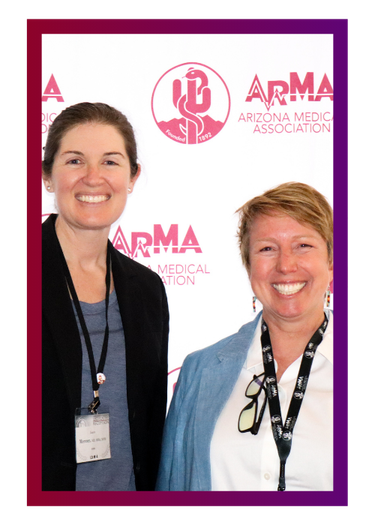
We're proud to introduce Laura Mercer, MD, as ArMA's April Member Spotlight.
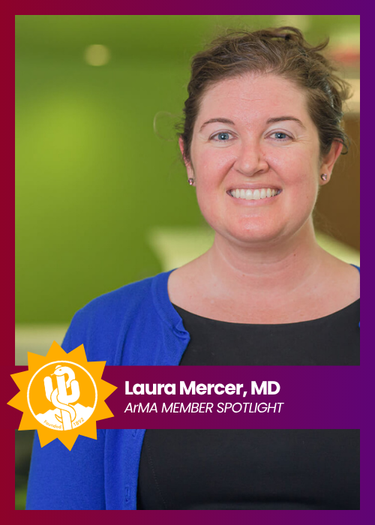
Dr. Laura Mercer is an OBGYN practicing at a community health center in Phoenix, where she cares for some of the city's most vulnerable patients. She also regularly serves patients near the Arizona-Mexico border and in Tuba City.
Beyond her clinical work, Dr. Mercer serves on ArMA's Board of Directors, teaches a personal development course, advocates for reproductive health, and influences health policies at the Arizona State Capitol. Organized medicine has become a cornerstone of her career — enabling her to dive more fully into her passions and connect with other physicians who feel the same.
In her interview with the Arizona Medical Association, she reflects on her winding path to medicine, navigating a new era of medicine, and feeling called to help those who need it most.
Read more about Dr. Mercer and her journey below!
Watch Dr. Mercer's Full Interview
In this conversation, Dr. Mercer shares her path to specializing in obstetrics and gynecology, her experience caring for patients at a community health center and near the Arizona-Mexico border, and her vision for physician-led advocacy in a rapidly changing healthcare landscape.
Career Journey
What drew you to a career in medicine and, more specifically, obstetrics & gynecology?
"I started college as an engineering major because I loved math and science. I quickly figured out that I was bored doing too much computer work by myself and went on to change my major no fewer than 20 times before eventually settling on a plan to apply to medical school.
As the first physician in my family, and apparently a not very observant child or thorough researcher prior to applying to med school, I arrived at orientation without knowing that I'd be expected to pick a specialty at the end of medical school. I had no idea that residency was a thing that happened. Fortunately, the TV show Gray's Anatomy was just starting around that same time, so I eventually picked up on those sorts of structural basics about a career in medicine. I remained undecided until part of the way through my 4th year, but eventually figured out that I was way more interested in going home and reading about my OBGYN patients than I was going home to study liver failure or prostate symptoms (which felt like more of a chore)."
What's the best advice you've ever received?
"You can do anything, but you can't do everything."
You currently practice at a community health center in Phoenix, where you serve some of the most vulnerable patients in our city. How has this experience changed or informed your approach to and philosophy on the practice of medicine?
"There's an MLK quote that says 'Injustice anywhere is a threat to justice everywhere' — and I think about this often. For all of the great advances in medicine, science, and technology, there are still so many people in our society that can't access even some of the most basic healthcare."
What was the biggest pivot point in your career?
"I was so burned out at one point, and I couldn't figure out how to fix it. My whole life, when something was really hard, the solution was always just to 'work harder.' But with burnout, the solution is often to 'work less' — and that was a really hard lesson for me to learn."
Community & Care
In addition to your work at the CHC, you often care for patients near the Arizona-Mexico border. What has surprised you most about delivering care in this area of our state?
"Practicing in rural parts of Arizona is a constant reminder of how there are low resource areas right in our own back yard. I often work with students or residents who express a desire to travel internationally for medical missions — and I can't help but think about the needs of our own rural communities in accessing healthcare, right here in Arizona."
Where is your favorite place to grab food in Arizona?
"My favorite tortillas are at Carolina's. And my favorite location is the original one on 14th Street near the airport in Phoenix."
Advocacy & Reproductive Health
The practice of medicine broadly has been in the limelight over the past several years as public perceptions continue to shift on healthcare, public health, and more. This is especially true for OBGYNs, who continue to navigate national and local policy changes on reproductive health. How have you personally navigated this shifting ground?
"With great effort. It's a lot to pay attention to health policy, legislation, and the courts, not to mention individual hospital policies. Our professional organizations, like ArMA and ACOG, have been instrumental in helping to simplify what is going on, and helping to figure out where advocacy is needed when harmful laws are threatened or enacted.
ArMA recently won a lawsuit to nullify many of the harmful anti-reproductive health laws that were still on the books in Arizona even though those laws were in direct conflict with Arizona's constitutional amendment protecting access to abortion. I'm so thankful to ArMA for its role in clarifying how we can take care of patients — removing barriers and confusion."
If you weren't practicing medicine, what would you be doing?
"I'd be a high school science or math teacher, and I'm guessing I'd have a different but overlapping set of advocacy considerations in that role too."
On top of your clinical work, advocacy efforts, and leadership roles, you also teach a personal and professional development course. What is one nugget of knowledge from the course you wish you could pass along to all your colleagues?
"We never really stop learning — and I think it's that thirst for knowledge that keeps us sharp and makes us good doctors. Having the humility to recognize that there's lots we don't know is so important."
What prompted you to become involved in organized medicine?
"When I was little, there was a saying 'two heads are better than one' — which was how my parents or teachers would suggest that I should ask for help and work with others on a team to figure things out. And I guess that really stuck with me, only now I realize how lots of really smart heads are even better. Organized medicine lets us be a unified force to work through complex issues and advocate for our patients and our profession."
What would people be surprised to learn about you?
"I am absolutely befuddled by time zones, particularly around the months where the rest of the country is arbitrarily moving their clocks around. I wear my Native Arizonan status with pride on this topic."
Why is ArMA important to you?
"ArMA brings together the House of Medicine in Arizona — across all specialties. We really do speak more loudly when we speak together. And in today's climate, medicine and science needs all the advocacy it can get."