
Member Spotlight: Ashish Patel, MD
We're proud to introduce Ashish Patel, MD, as ArMA's September Member Spotlight.
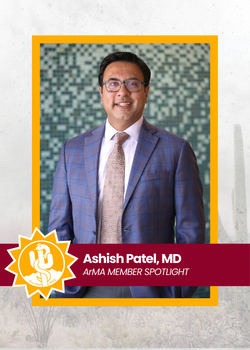
Dr. Ashish Patel is a pediatric gastroenterologist serving as Phoenix Children's Physician-in-Chief. In this role, he leads over 900 physicians, advanced practitioners, and mental health therapists in pursuing the medical group's mission. Even as he leads within the state's largest pediatric health system, he remains passionate about engaging with patients and contributing to research that shapes healthcare globally.
In his interview, Dr. Patel talks about how he achieves a careful balance between strategic leadership and the core of every physician's profession: patient care. He also brings a fresh perspective on Arizona, its merits, and its culinary scene, having recently relocated from Texas.
From medical research to clinical care to systems thinking, Dr. Patel demonstrates all of the unique skill sets that make physicians invaluable in our communities. He is not only shaping healthcare for the better but finding a rhythm in work that allows his passion for medicine to grow.
Read more about Dr. Patel and how he is shaping pediatric healthcare in Arizona below!
You currently serve as Phoenix Children's "Physician-in-Chief," which you were appointed to in 2024. What do your days look like while serving this role and which aspect do you enjoy the most?
As Physician in Chief, I lead over 900 physicians, advanced practitioners and mental health therapists within Phoenix Children's Medical Group. Our health system is the largest provider of pediatric health care in the state and that comes with great responsibility to children and their families. My days are a combination of administrative time and clinical work, which was very important to me when I accepted this role. I love clinical medicine and as a pediatric gastroenterologist who specializes in pediatric inflammatory bowel disease, I could not see giving up my passion for caring for children and their families.
My current leadership position allows me to share this passion throughout our health system to impact care delivery in our more than 75 subspecialties, plus our primary care practices. I'll be honest, some days my calendar looks like Tetris but with a great support team and keeping in mind our mission "To advance hope, healing and the best healthcare for children and their families", it has been a rewarding journey so far!
How did you find yourself specializing in pediatric gastroenterology? Did you always have a passion for caring for children and their health?
My mom was a general pediatrician in a small town in Texas and I loved how she talked about taking care of families and often generations of children. I went into medical school knowing I wanted to do pediatrics and I was first exposed to pediatric gastroenterology in residency. I loved the diverse disease process involving many different organs of the gastrointestinal tract as well as the opportunity to use endoscopy to diagnose, treat and sometimes cure these diseases.
Where is your favorite place to grab food in Arizona?
\I am a huge foodie and love the explosion of the culinary scene here in Arizona! Some of my favorite spots are Uchi, Little Miss BBQ and Bacanora.
You have an impressive track record of research and publication, with over 50 original publications, guidelines, and reports. Which part of the research and publication process do you find most fulfilling or exciting?
Research continues to be an important part of my career. I always felt like participating in research was a way to push medicine forward, learn what we don't know and help future generations of children. When you see a patient in clinic, you are focused on their health and their success.
Research allows you take a more global approach to a disease and try to make an impact that will affect many more children.

What was the biggest pivot point in your career?
Moving to Arizona! I was part an excellent medical group in Dallas and had been there for 17 years when the opportunity came up to be Division Chief of Gastroenterology at Phoenix Children's. Since taking that role, the division has achieved significant growth, going from 15 doctors to 25, plus launching the first pediatric gastroenterology fellowship in Arizona. That work translated to the opportunity to be Physician in Chief, which I am fully engaged in now.

What prompted you to become involved in organized medicine?
I like being involved in organized medicine because it allows us to share our voice, address concerns and frustrations, and in the end hopefully make medicine better. I'm involved nationally with the North American Society for Pediatric Gastroenterology (NASPGHAN), our pediatric gastroenterology organization. I'm also involved with a large pediatric IBD collaborative called ImproveCareNow.
What do you like best about living in Arizona?
My family loves all the outdoor activities Arizona has to offer, especially going up to Flagstaff. Our favorite Indian restaurant in Arizona is up there, called Delhi Palace. We love sports and the arts, so we enjoy going to Suns games (even though I am a die-hard Spurs fan), Cardinals games, concerts and have season tickets to the Arizona Speaker Series.
Why is ArMA important to you?
When my family and I moved from Texas to Arizona in 2020, the Arizona Medical Association allowed me to start connecting with other physicians and learn the challenges and successes we experience in Arizona.How do you unwind after a stressful day?
I spend time with my kids and explore the culinary scene in Phoenix and across Arizona.
What personal or professional achievement are you most proud of?
On a personal note, my wife is an accomplished pediatric hospitalist at Phoenix Children's. I love watching our two kids grow up and become great human beings.
What is something on your bucket list you hope to cross off soon?
My family loves to travel, so we have several places on our bucket list. We went to Argentina last year which was incredible. Iceland, Africa and Europe are high on the list!