Meet Dr. Adam Brodsky
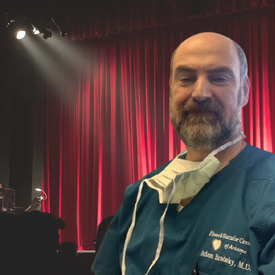
Meet Adam Brodsky, MD
The ArMA Member Spotlight this month is Dr. Adam Brodsky. He practices at the Heart & Vascular Center of Arizona in Phoenix and specializes in interventional cardiology. Dr. Brodsky has been a member of ArMA since 2005, and he has served on ArMA's Board of Directors and Bylaws Committee. Dr. Brodsky demonstrates a deep passion for providing quality healthcare, and ArMA is grateful for his membership.
Learn more about Dr. Brodsky below!
What inspires you?
The trust people give us. It is a thing not to be wasted, misused, or abused. It is not for personal gain or pleasure that we acquire this trust. In a world of very little trust, where community and trust seem to be unraveling all around us, we should pause and take note of the never-ending amount of trust which is freely given to us, and we should not squander it.
What has been the most memorable event in your career?
I had the opportunity to practice medicine in Israel for a period of time. It was exciting to use my skills in a foreign country, to learn from a new culture, and to teach a little. It was enlightening to change perspective for a time. Living and working at the root of three major world religions was an honor I do not take lightly.
What do you like doing in your spare time?
I enjoy flying my PA-46 Piper Malibu, camping, hiking, reading, and pondering the world in which we live. Regarding the question, sometimes the opposite of “doing” is OK. Getting away from distractions and being alone with your thoughts and loved ones is rewarding and refreshing.
How did you meet your spouse?
We were both medical students in Chicago and had common friends at a business school there. We both attended a business school extracurricular event and found we were the only two medical students in a sea of business students. The rest, as they say, is history.
Do you speak any languages other than English?
I speak a bit of Hebrew.
What is one message you would give to your 18-year-old self?
Don’t worry too much; it all works out. Although you’re focused on your career, you are not defined by your career. Before you leave your parents’ world to embark on your own journey and acquire your own stuff, remember you will be successful. You’re smart and blessed with everything you could want. You’ll succeed and get what you need. You don’t need to focus so much on obtaining things you think you need. Need is like inflation — it is relative and therefore grows because everything else around it grows. It is possible to remove yourself from that never-ending game and find satisfaction in your contributions rather than in your acquisitions.
What prompted you to become involved in organized medicine?
I don't mean for this to be taken in the wrong way, but there was no one else to do it. On the one hand, it takes time away from my family. It is sometimes tedious and uninteresting. However, when there is a need and you look around and that need is unfilled, and you know in your heart that you could do it and probably do it well, then it is your obligation to assist. ArMA is important. Despite the individualistic nature of America and physicians in particular, we cannot endure as a simple collection of random individuals. We must interface with the community in which we live as a united whole. Decisions will be made about the practice of medicine in our community regardless of our level of engagement. Therefore, it is incumbent on us to maintain a strong collective voice.