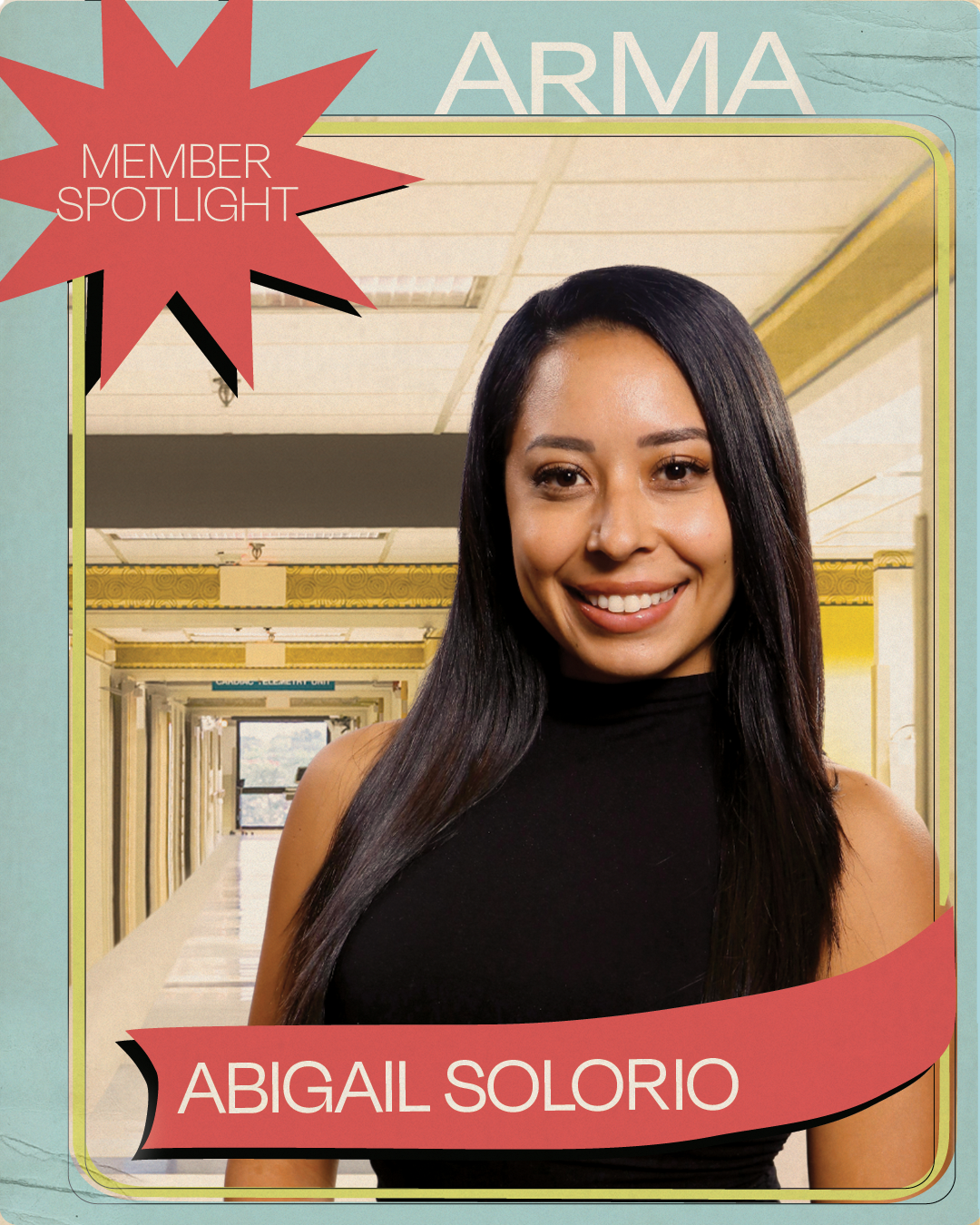
Meet Abigail Solorio!

September 6, 2022
Portrait of Leah Sanford in glasses, smiling against a gray background with a purple frame and award badge.

We are pleased to introduce you to Abigail Solorio, the Arizona Medical Association (ArMA) Member Spotlight for September. Abigail is obtaining her medical education from the University of Arizona College of Medicine-Phoenix. She is pursuing a career in primary care, with a particular interest in family medicine.


In her interview for the Member Spotlight, Abigail shares her important story of being a first-generation, underrepresented minority in medicine. If you take a moment to read about Abigail's experiences, you'll find that her passion for practicing medicine is deeply rooted, and her outlook on life is inspiring.


You can read about Abigail’s journey with medicine in the interview below! 👇

What inspires you?


My family is my greatest source of inspiration, and being a big sister has been one of my favorite roles in life. My family’s endless encouragement motivates me daily to pursue my passions. My mother instilled in me the importance of celebrating the diversity of our community and serving others with compassion, and I hope to set an example by reflecting these values in my work. I am grateful for the many lessons she has taught me; I have admired the strength, dedication, and kindness she displays in every interaction. I would not be where I am today without her unconditional love and support.


What do you enjoy doing in your spare time?


Traveling is my passion, and any chance I get, I am searching for a new adventure. I have prioritized balancing medical school, extracurricular activities, and making time to travel, explore different cultures, and create memories. I can be the best physician for my patients, a friend to my peers, and feel most fulfilled when I tend to my passions. In the past few years, I have been able to travel to Italy, Greece, Turkey, Canada, Mexico, the Dominican Republic, Puerto Rico, Hawaii, and more!


What is one message you would give to your 18-year-old self?


Keep your eyes on the stars and dream big! My mother instilled in me from a young age that if my heart was truly set on something, there would always be a way to achieve it, even if it seemed unreachable. The challenges that once felt impossible to overcome and experiences that felt like setbacks will propel you forward. Trust the process and when you find yourself with a seat at the table, use your voice proudly, lift others and advocate for change.


What is the one accomplishment you’re most proud of?


As a first-generation, underrepresented minority in medicine, this journey has been nothing short of a dream come true. As a first-year medical student, I had the privilege of being in the first cohort of students awarded the Primary Care Scholarship, established to address the physician shortage within Arizona by covering tuition associated with medical education, specifically for students committed to practicing primary care in an underserved community. This accomplishment represented not only the support of an entire community, one that has shaped my life and served as my motivation, but it was the culmination of the effort, love, and resiliency that has been poured into my life over the years. 


What’s your idea of a perfect day?


Any day I get to spend with my family is a perfect day. We love watching movies and sharing a great meal; plus, nothing is better than enjoying ice cream together. Ending the day with gratitude, taking time to reflect, and setting aside a few moments for mindfulness is my favorite way to reset and wind down. 


What prompted you to become involved in organized medicine?


Practicing medicine is an honor, a privilege, and one I am humbled to call my passion. It is a position I don’t take lightly, as I believe a career in medicine comes with a responsibility to strive to improve health outcomes for all and take on a leadership role. Raised in an underserved community of immigrants facing several socioeconomic challenges, I witnessed firsthand the existing disparities and the facets of medicine that need to be addressed. The challenges we faced inspired me to dedicate my time to leadership, advocacy, and working with medically underserved communities, devoting myself to actions and progress. These past few years have affected us in more ways than one, and I am moved by the physicians who pledge to enter a field and confront the challenges in our society. I believe our community needs healing now more than ever, and I am grateful to be a part of this process. It is inspiring to come together and unite in our efforts. We have the power to advocate for change and the opportunity to bridge the gap between what is and what can be.


By Admin User • September 18, 2026
Statewide orders keep pharmacists and physicians authorized to vaccinate Arizonans amid uncertainty over the next ACIP meeting. Statewide Orders Cover the 2026-27 Flu & COVID Season The Arizona Department of Health Services has issued statewide standing orders supporting access to the 2026-27 influenza and COVID-19 vaccines approved by the U.S. Food and Drug Administration. Arizonans seeking a flu or COVID-19 vaccine should contact their physician or pharmacy to confirm availability. Why the Orders Were Issued Arizona pharmacists may administer vaccines recommended by the Advisory Committee on Immunization Practices, vaccines recommended by the Centers for Disease Control and Prevention for international travel, or vaccines authorized under a prescription, including a physician-issued public health standing order. With the timing of the next ACIP meeting uncertain, ADHS worked with the Arizona Board of Pharmacy to issue statewide standing orders for the flu and COVID-19 vaccines, which function as a prescription allowing pharmacists and physicians across Arizona to administer them to anyone who wants one. ADHS Medical Advisor Weighs In "Vaccines are one of the most important tools we have to protect our communities. The Influenza and COVID-19 vaccines have been proven safe and effective at preventing severe illness, hospitalization, and death. Vaccines help us limit the spread of disease, reduce pressure on our healthcare system and reduce costs," said Dr. Richard Carmona, ADHS public health medical advisor and the 17th U.S. Surgeon General. "We have issued these standing orders to ensure safe and timely access to the vaccines in alignment with scientific and evidence-based guidance." What Arizonans Should Know The standing orders do not require every pharmacy to offer vaccinations, and they do not guarantee insurance coverage for administration. Coverage and out-of-pocket costs vary by plan, so Arizonans should check with their insurance provider before scheduling an appointment. 
By Admin User • September 18, 2026
State attorneys seek an emergency stay after lower courts reject bids to delay receivership of the prison health care system. State Makes a Last-Ditch Appeal Attorneys for the Arizona Department of Corrections, Rehabilitation and Reentry asked the U.S. Supreme Court this week to delay a court-ordered receivership of the state's prison health care system. The request comes after both a federal district court and the 9th U.S. Circuit Court of Appeals declined to pause the takeover. In the recent application, former U.S. Solicitor General Paul Clement, a representative of the department, argued that the state deserves more time to make its case before surrendering control of its operations, including oversight of its employees and health care budget. Roots of the Case The dispute began in 2012 when inmates sued the department, alleging the prison system's inadequate medical, mental health, and dental care amounted to cruel and unusual punishment under the Eighth Amendment. The case went through years of litigation and a failed settlement agreement. In 2023, U.S. District Judge Roslyn Silver ruled that the health care system was "grossly inadequate." The court ordered the prison healthcare system to comply with more than 150 "quality indicators," but according to court-appointed monitors, the department failed to comply with 131 of the measures. In light of this finding, Silver named Annette Chambers-Smith, former director of the Ohio Department of Rehabilitation and Correction, to take over as receiver effective Oct. 19. Arguments on Both Sides Clement argues receivership should be the last resort and that Silver moved to it too quickly. He asserts that the department has made measurable progress, including growing its health care staffing by more than 50%, expanding substance-use treatment access, and adopting a new care model. Corene Kendrick, deputy director of the American Civil Liberties Union National Prison Project, which represents the roughly 25,000 people incarcerated in Arizona prisons, called the department's request a "Hail Mary" and said Silver had given the department years of opportunities to comply before ordering receivership. What Happens Next The Supreme Court has not yet set a deadline for the plaintiffs to respond to the stay request. Separately, the 9th Circuit is now reviewing the merits of the receivership order itself. The department filed its opening brief on Sept. 15, and the plaintiffs' response is due Oct. 15. Information in this article was sourced from the Arizona Mirror .