ArMA Member Spotlight: Theresa Costales, MD!
We're proud to introduce Theresa Costales, MD, as ArMA's April Member Spotlight!
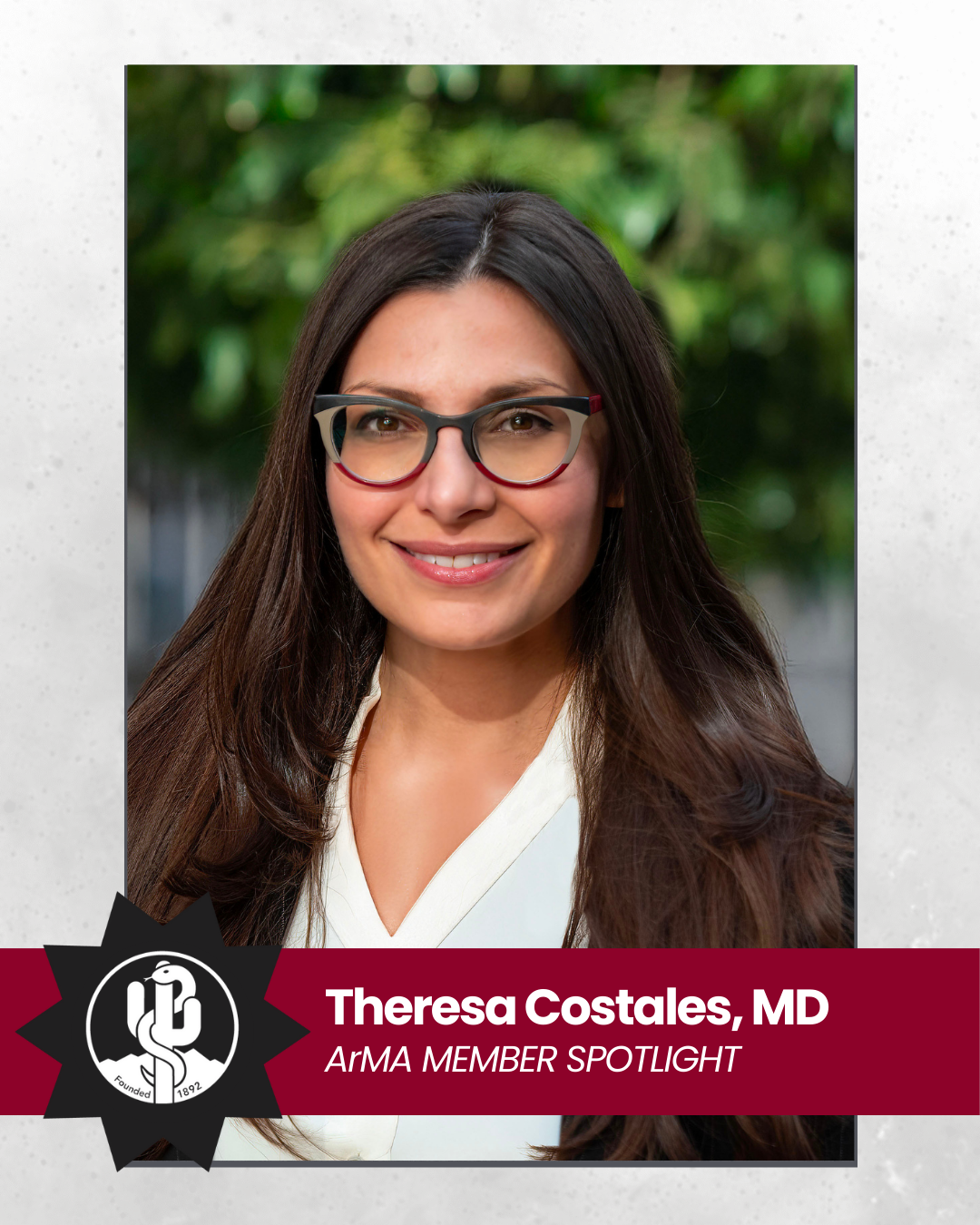
Dr. Costales is a Phoenix-based psychiatrist and the newly appointed Chief Medical Officer of AHCCCS, Arizona’s Medicaid agency. With a career grounded in behavioral health, a passion for systemic reform, and a drive to serve vulnerable communities, she brings both lived experience and visionary leadership to her role.
From her early work in adolescent addiction treatment to overseeing a statewide psychiatric crisis center, Dr. Costales has remained steadfast in her belief that better systems lead to better care. Today, she stands at the helm of a program serving over 2 million Arizonans, committed to reshaping healthcare delivery and defending access to care.
Learn more about Dr. Costales's story below!
What aspect of your work as AHCCCS’s CMO do you find most fulfilling or exciting?
"I just came on board with AHCCCS in January, so at this early stage of my tenure, it’s still really thrilling to consider the potential scope of impact. AHCCCS provides health insurance coverage to over 2 million Arizonans, covering more than half of all births and two-thirds of nursing facility days in the State. As the Arizona Medicaid agency, we oversee the AHCCCS Complete Care plans, the RBHAs (which are responsible for care of patients with a Serious Mental Illness designation), CHP (which covers care for children in DCS custody), the ALTCS plans (which provide long-term care coverage for the elderly and physically disabled, as well as for the developmentally disabled populations), and the Fee for Service System (which includes the American Indian Health Program, the Federal Emergency Services program, and the Tribal ALTCS and RBHA IGAs).
It’s hard to find an area of healthcare in Arizona that AHCCCS does not touch. And as a physician who spent much of my time on the community provider side contemplating ways by which our healthcare system could and should work better for patients, I almost cannot believe that I am here being given the opportunity to turn those daydreams into reality."
How does your expertise in behavioral health influence you in your current role?
"I came to Arizona in 2019 to work in the Serious Mental Illness (SMI) system here. It was my first real job after training, and I was excited to continue consolidating the knowledge I had gained during residency by treating chronically mentally ill patients in a statewide system designed to do just that. I had never heard of such a system – they do not exist elsewhere – and I could not wait to start.
I had formed this image in my head of what the SMI system would be, and it included truly integrated physical and psychiatric treatment, easy access to high quality services and evidence-based treatments of various modalities, sophisticated care coordination, and evidence of great outcomes, such as lower rates of psychiatric hospitalization and recovery from SMI.
Unfortunately, that’s not what I encountered upon arrival. I spent my days fighting for my patients to receive care that could be considered even mediocre in quality, navigating a somewhat disjointed system full of barriers to do so, and over time, I watched patients get sicker and sicker. I started to get a picture of where the gaps were, and which, if addressed, had the potential to be most impactful for the patients.
That picture truly came into focus when I left the SMI clinics to oversee a psychiatric crisis center, where all parts of the system seem to connect. It was there that I began advocating for systemic change while simultaneously advocating for individual patients, and that both led me to my current role at AHCCCS and informed my perspective on what that role should look like."
Looming Medicaid cuts are on everyone’s mind. What would you say to policymakers who are considering cuts to this funding or changes to patients’ eligibility?
"Put simply, making any significant cuts to Medicaid funding and/or eligibility would be short-sighted, harm many Americans, weaken our economy, and adversely impact the electability of any policymaker who voted to do so. So, if I had the chance, I suppose I would advise against doing so."
What is something unexpected that you’ve encountered in your transition from direct patient care to leading a large healthcare institution?
"I came to AHCCCS with an understanding that problems in our healthcare system would be complicated and have multiple layers, but I had no concept of how numerous and entangled those layers would be. It turns out there are very few truly “easy fixes” in a statewide agency."
What goal are you most excited to accomplish in 2025?
"Just making it through my first year as CMO of a state Medicaid agency in the current political climate in one piece will be a win for 2025."
What song has been on repeat lately?
"The Fever to Tell album from Yeah Yeah Yeahs is experiencing a revival in my car of late. That album debuted towards the end of my Senior year of high school, so when I first listened to it, I was preparing to leave the proverbial nest, and still had all of that teenage angst going on, but was simultaneously so excited about the future, which I hoped would include making the world a better place. The songs feel full of all of those emotions and sentiments, with a hefty dose of formidable female energy, all of which feels oddly relevant to me once again, and is totally helping me prepare for my day as the AHCCCS CMO."
Where is your favorite place to grab a bite in Arizona?
"Phoenix City Grille – it was the neighborhood spot that my husband and I frequented in the first place we lived together, and we got to know the staff there pretty well, some of whom have been watching our son grow since he was still in the womb. Though we have since moved to another neighborhood, it is still our go-to for a family dinner or Friday date night."
What’s the last book you read?
"In all honesty, the last book I actually read cover to cover was Harry Potter and the Sorcerer’s Stone, which I read to my 6-year-old daughter at bedtime over the last month or so. I think learning to read has been the first major cognitively challenging skill she has attempted to master, which was leading her to avoid it as much as possible, so I wanted to get her excited about reading by showing her how it can unlock new worlds and endless adventures, and decided the Harry Potter books were the way there. The plan seems to be working."
How would you describe your approach to patient care?
"When supervising medical students, residents, PAs or NPs, I often say, 'When in doubt, be a human.'
I see my patients as people first and foremost, and I want them to experience me that way as well, which means that I present during visits as myself – personable, warm, and as imperfect as humans tend to be. I make an effort to get to know my patients, because the better I understand them, the easier it is to get to the root cause of what’s troubling them. I self-disclose at times, always thoughtfully and with the intention of building therapeutic rapport, which is key to eliciting a good history and getting buy-in for a treatment plan.
When I don’t know something, I tell them that I don’t know and then discuss how we can figure it out. When I’ve made a mistake, I acknowledge that I did so, apologize, and do what I can to fix it. And when they need someone to fight for them or help them to navigate a complex system, I am there for it. I treat my patients the way I would want a loved one to be treated. "
What prompted you to become involved in organized medicine?
"The Associate PD in my residency program once said to me, 'You are someone who always need a project,' which I have since found to be highly accurate.
It seems to be in my nature to reject the status quo and instead seek continuous systemic improvement, so it was really less of a conscious choice to get involved in organized medicine and more of a compulsion. Finding ways to make the system better is what drives me, so I tend to find my way to positions that allow me to focus my energy there."
Why is ArMA important to you and those you lead?
"ArMA is the collective voice of the experts who do the work, and can thereby provide a perspective on AHCCCS initiatives that is critically important to seeing our mission through."