
ArMA Member Spotlight: Gretchen B. Alexander, MD, DLFAPA!
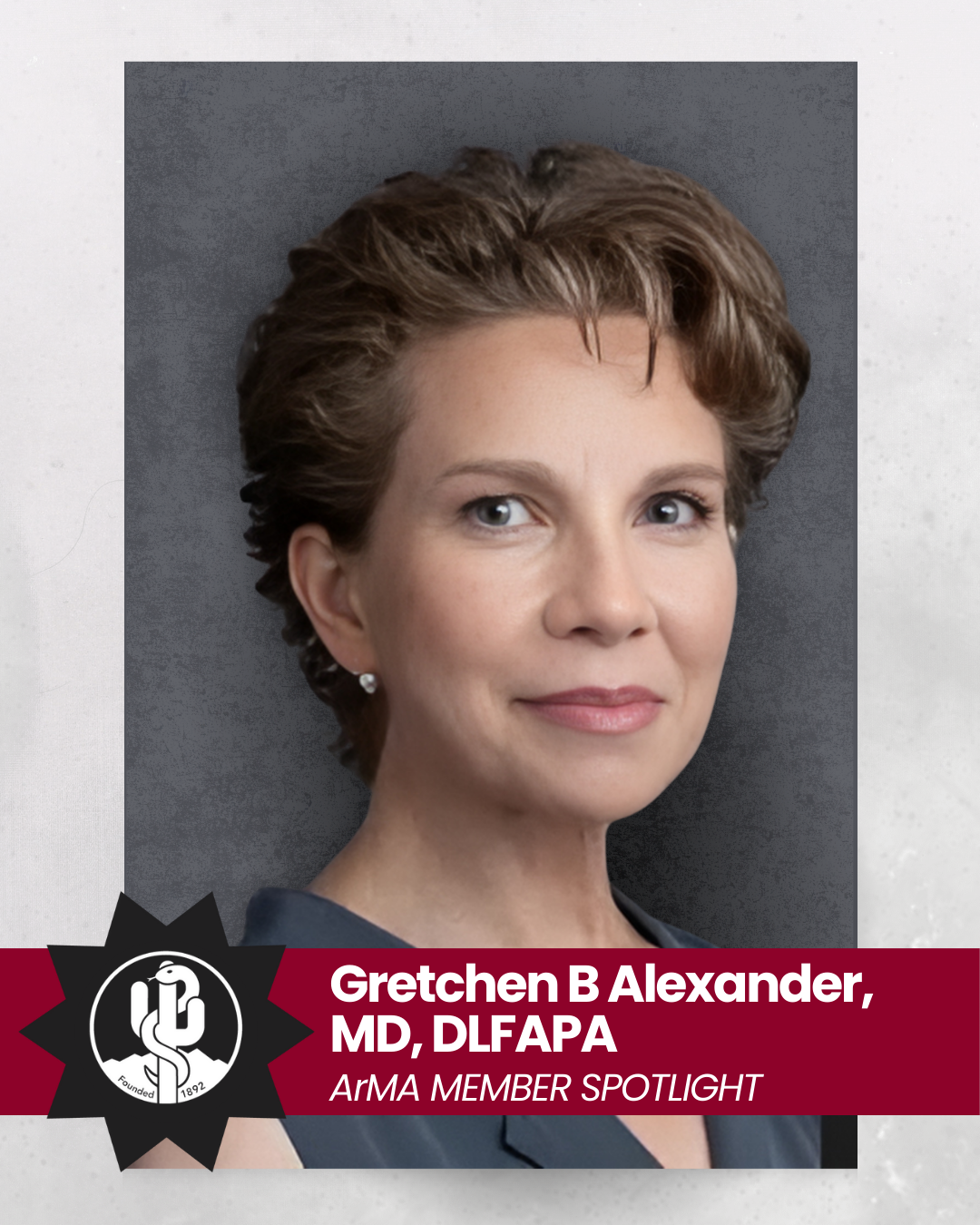
This month, we introduce Gretchen B. Alexander, MD, DLFAPA as August's ArMA Member Spotlight! Dr. Alexander works as a board-certified psychiatrist caring for patients in the Phoenix metro area. Dr. Alexander attended the Perelmen School of Medicine at the University of Pennsylvania and completed her psychiatric residency training at the Long Island Jewish Medical Center.
Dr. Alexander led ArMA as president from 2017-18 and currently serves as Chair of the Medical Aid in Dying Task Force and Chair of the Arizona Medical Political Action Committee's Board of Directors. She recently was recognized with the Distinguished Service Award during the Heart Beat Gala at ArMA's 2024 Annual Meeting.
Read into Dr. Alexander's award the 2024 Health Care Award Ceremony!

What inspires you?
"As a psychiatrist at Maricopa County’s safety net hospital, I work with patients who are struggling with the gravest challenges—medical, emotional, economic and social. Trying to make sure that our patients leave the hospital with a sense of hope about the world and their situation is a consistent goal for me and our entire group; meeting that goal is a powerful inspiration to me."
What are your 3 favorite movies?
"Albert Brooks’ Defending Your Life, The Adjustment Bureau with Matt Damon and Emily Blunt, and Ingmar Bergman’s The Seventh Seal.”
What does a typical day in your life look like?
"My day starts at 6:45AM reviewing emails and checking for overnight transfers to the medicalcenter from inpatient psychiatry, since we need to follow those cases.
At 7:00AM I start our group’s daily group chat and assign the overnight consults, discuss dispositions and transfers for active cases, and introduce new trainees to the team.
At 8:00 I head down to the hospital for 8:15 table rounds where we review all cases, discuss interesting/educational aspects of patients we’re seeing and coordinate the legal work on patients who are on involuntary status. Sometimes we have a med student give a presentation on a topic which is always interesting.
From 8:45-11:00 I assign work to the resident and medical student on my team, deal with administrative matters , review charts, and call families and outside providers for collateral information on my forensic and risk assessment cases. Sometimes I will have a lecture to give for our residency training program.
From 11:00 to 4:30 I’m on the floors seeing patients, staffing cases with the residents, communicating with medical and surgical teams about the cases they’ve consulted us on, putting out administrative fires, and teaching our medical students.
From 4:30-5:30 or 6 I’m back in my office finishing notes and returning phone calls, or in the ED seeing late consults."
What is a meaniful project to you that you're currently working on?
"Currently, I serve as board chair for the Arizona Medical Political Action Committee. Our role as board members is to support our amazing legislative staff as they advocate for our patients and our profession at the state legislature. I am grateful to have this opportunity to engage with our membership and ArMA leadership as we work to improve our fundraising and advocacy work. ArMA’s effectiveness at the state legislature is closely tied to our engagement with state lawmakers and our PAC is just one of many tools which can be extraordinarily effective in building strong relationships with our allies. Those strong relationships are a critical foundation when we seek to get laws written and passed that will help us achieve our legislative goals."
What is a meaniful project to you that you're currently working on?
"Currently, I serve as board chair for the Arizona Medical Political Action Committee. Our role as board members is to support our amazing legislative staff as they advocate for our patients and our profession at the state legislature. I am grateful to have this opportunity to engage with our membership and ArMA leadership as we work to improve our fundraising and advocacy work. ArMA’s effectiveness at the state legislature is closely tied to our engagement with state lawmakers and our PAC is just one of many tools which can be extraordinarily effective in building strong relationships with our allies. Those strong relationships are a critical foundation when we seek to get laws written and passed that will help us achieve our legislative goals."
How would you describe your approach to patient care?
"Old School: I trained in an era where being detail oriented, thorough and curious about your patients was of paramount importance to being a good physician. So when I walk into a patient’s room, I have already reviewed all of their medical records in detail, sometimes back to the 1990’s. This allows me to spend far less time trying to get the patient to remember their often complicated past history, and to spend more time just chatting with the patient and establishing rapport and addressing their current concerns. "